
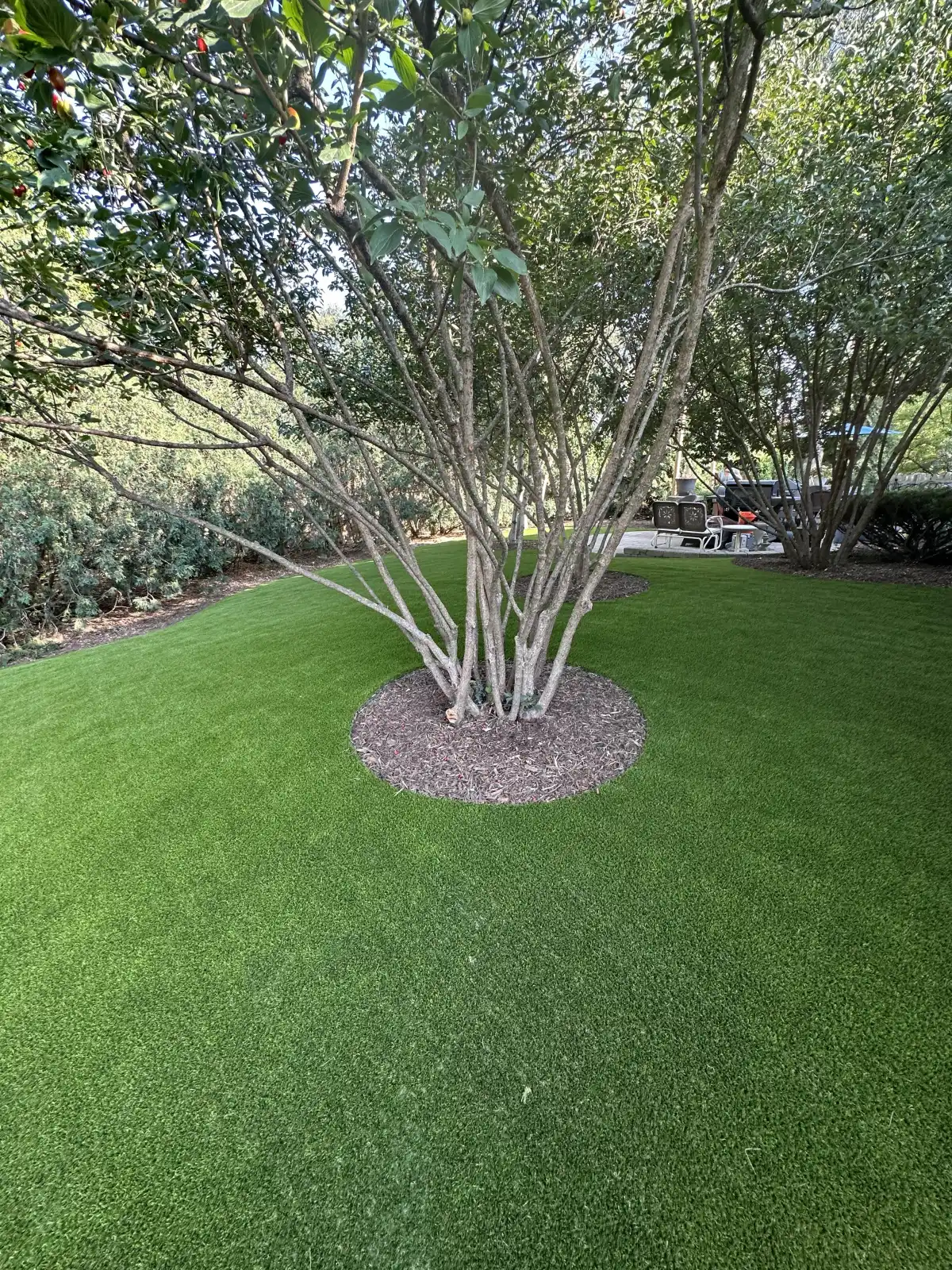
Great Lakes Synthetic Turf currently uses $13 to $15 per square foot as an early planning range for many professional residential turf installations in Michigan. At that range, 1,000 square feet calculates to $13,000 to $15,000. Smaller areas can be multiplied the same way, but the result becomes less reliable as the footprint shrinks because every installation still needs delivery, preparation, fitting, and cleanup.
This guide is for the homeowner who has approximate dimensions and wants to turn them into a useful first budget. If you are already holding proposals, use the separate line-by-line quote comparison guide. If you want to understand which design and site choices move the total, read what changes an artificial turf quote.
Start with three numbers: the visible area you want covered, the perimeter that must be finished, and the material quantity needed to fit the shape. A 500-square-foot rectangle and a 500-square-foot yard wrapped around trees may have the same finished area but very different cutting, edging, seam, and waste requirements.
Synthetic turf cost examples for common yard sizes
The table applies the established $13 to $15 planning range to the finished square footage. It is budgeting arithmetic, not a promised installed price or a substitute for measuring the site.
| Finished area | At $13 per sq. ft. | At $15 per sq. ft. | How to use the number |
|---|---|---|---|
| 100 sq. ft. | $1,300 | $1,500 | Arithmetic only; ask about minimum project scope and access. |
| 200 sq. ft. | $2,600 | $3,000 | Useful for a first budget, but small-area fixed work can change the rate. |
| 500 sq. ft. | $6,500 | $7,500 | Confirm whether the measured shape fits turf rolls efficiently. |
| 1,000 sq. ft. | $13,000 | $15,000 | A stronger scale estimate once the site and written scope are known. |
Why 100 or 200 square feet may not price by multiplication alone
Small areas still require a crew to arrive with tools and materials, remove the existing surface, prepare and compact the base, fit the turf, secure the perimeter, apply infill, groom the fibers, and clean up. Delivery and disposal do not disappear because the finished lawn is small. Curves, narrow side yards, steps, or hand-carry access can also put more labor into each square foot.
That is why the 100- and 200-square-foot figures above should be treated as calculation examples. Ask for a measured proposal before using them as a purchasing decision. A professional estimate should explain whether any project minimum applies and what that minimum includes.
Measure the finished footprint, then map the obstacles
For a rectangle, multiply length by width. Break an L-shaped yard into rectangles, calculate each one, and add the results. That gives you the approximate finished area. Then mark every tree, planting bed, post, utility cover, step, patio edge, walkway, downspout, and gate.
Those details affect more than square footage. A tree ring adds perimeter. A narrow strip may require careful roll orientation. Several fixed objects create cuts and can increase waste. Turf is ordered and fitted as material, not poured into the exact outline of the yard, so the purchased quantity may be greater than the visible finished area.
Separate the surface number from the installed system
A complete synthetic turf installation is a surface supported by preparation below it and finish work around it. When a budget is based only on turf square footage, these are the scope items most likely to be missed:
- Removal and disposal: what comes out, how deep the excavation goes, and how material leaves the yard.
- Grade and drainage: where rain, snowmelt, downspouts, and runoff move after installation.
- Compacted base: the aggregate, placement, grading, and compaction that support the finished surface.
- Perimeter and transitions: edges at planting beds, concrete, pavers, steps, fences, and other surfaces.
- Turf, seams, and infill: the product and quantities selected for the way you plan to use the yard.
- Finish work: grooming, cleanup, and any restoration outside the installation footprint.
Drainage questions belong in the budget
Synthetic turf lets water pass through, but the site still needs a place for that water to go. Standing water, compacted soil, low spots, roof runoff, or hardscape that drains toward the lawn may call for grading or a separate drainage solution. It is better to identify that work before installation than to price the surface as though the existing water pattern does not matter.
For a yard in Benton Harbor, the city name does not establish a price. Access, shape, grade, soil conditions, runoff, and intended use remain specific to the home. The same is true throughout the company's Michigan service area.
Build a first budget before requesting an estimate
- Measure the approximate finished area in square feet.
- Multiply by $13 and $15 to create an initial planning range.
- Photograph gates, steps, slopes, wet spots, downspouts, and fixed obstacles.
- Decide whether the surface is for an everyday lawn, pets, play, a pool edge, or a putting area.
- Ask the estimator to distinguish finished area, ordered material, included site work, and any allowances or exclusions.
Synthetic Turf Installation
See how the surface, base, drainage, edges, seams, and infill work together.
Benton Harbor Service Area
Explore turf, drainage, and outdoor services available in Southwest Michigan.
What Changes a Turf Quote
Review the site and design decisions that can raise or lower the installed total.
Get a site-specific synthetic turf estimate
Bring the approximate dimensions, photos, current surface, access details, intended use, and any known wet areas to the estimate conversation. Visit the contact page to call or email Great Lakes Synthetic Turf, or start with the guided online estimator.
Frequently Asked Questions
How much does it cost to install 1,000 square feet of synthetic turf?
Using Great Lakes Synthetic Turf's current Michigan planning range of $13 to $15 per square foot, 1,000 square feet calculates to $13,000 to $15,000. That is an early budget example, not a property-specific quote. Access, removal, grading, drainage, material layout, edges, seams, infill, and transitions can change the final scope.
How much would 200 square feet of synthetic turf cost?
Simple multiplication at $13 to $15 per square foot gives $2,600 to $3,000 for 200 square feet. Small installations may not price at that arithmetic result because delivery, equipment, mobilization, cutting, base preparation, and cleanup are still required. A measured estimate is the reliable answer.
How much is 100 square feet of synthetic turf?
At a $13 to $15 planning rate, 100 square feet equals $1,300 to $1,500 on paper. It should not be treated as a promised installed price. Ask about minimum project scope and whether the area has curves, obstacles, difficult access, drainage needs, or several transitions.
How much does it cost to have synthetic turf laid?
The installed cost depends on more than the turf roll. A complete proposal may need to account for removal and disposal, excavation, grading, drainage, compacted aggregate, edge restraint, turf, seams, infill, transitions, grooming, and cleanup. Compare both the total and the written scope.