
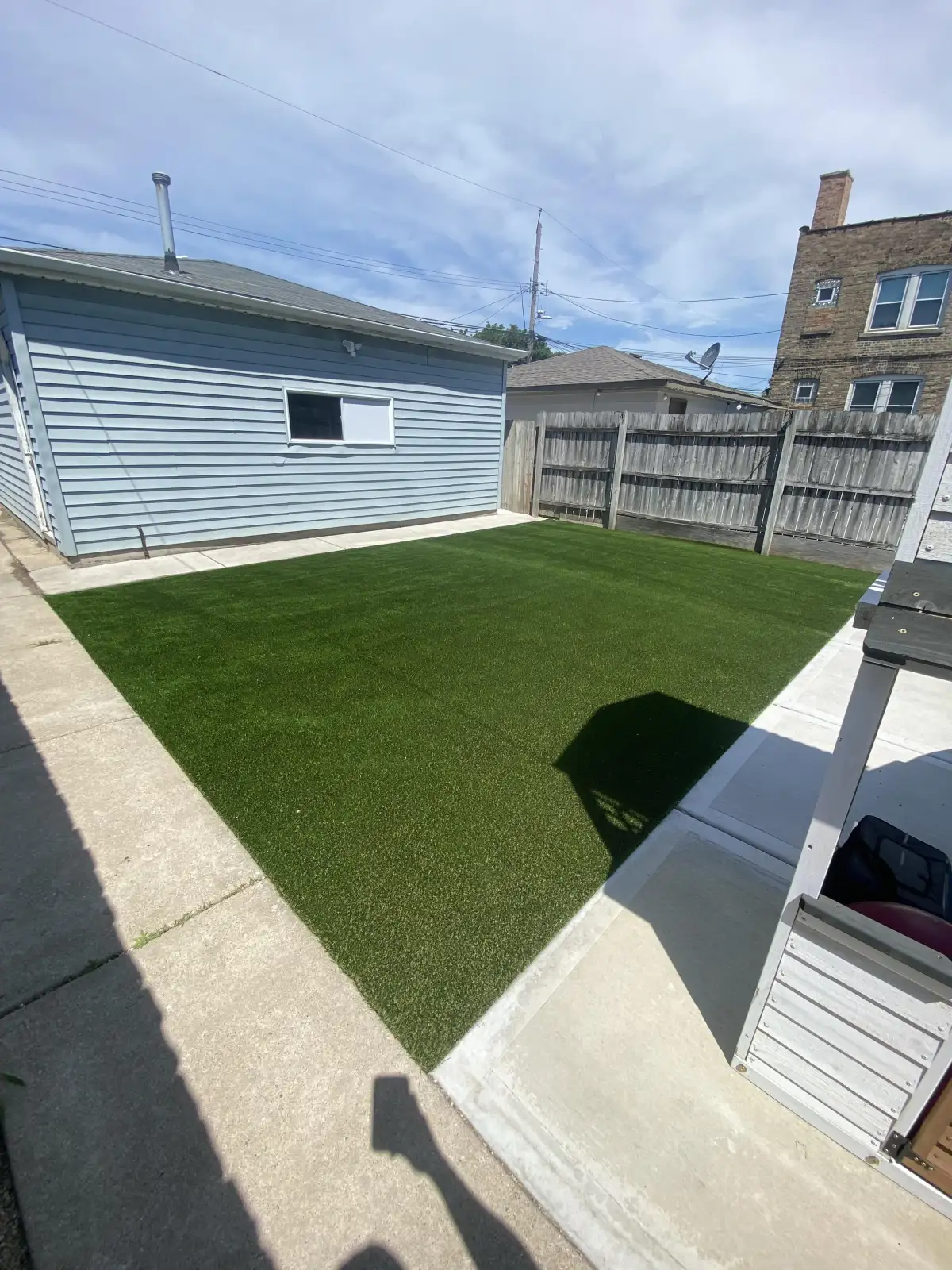
Great Lakes Synthetic Turf currently uses $13 to $15 per square foot as an early planning range for many professional residential turf installations in Michigan. At that range, a 1,000-square-foot area calculates to $13,000 to $15,000. That is useful budgeting math, not a site-specific quote: the final number depends on what has to happen below the turf and around its edges.
This guide answers a different question than our quote comparison checklist. Here, the focus is on the decisions that move your total before proposals are written—and which lower-cost shortcuts can create a poor result.
The short version: area sets the scale, while access, removal, grade, drainage, base construction, turf type, seams, perimeter length, and transitions determine how much work that area requires. A compact side yard can cost more per square foot than a larger open rectangle because the crew still has to move material, prepare the base, and finish every edge.
What a 1,000-square-foot turf budget does—and does not—tell you
Multiplying the measured footprint by a planning rate gives you a reasonable starting number. It does not establish the purchased material quantity or the final construction scope. Roll direction, curves, fixed obstacles, and seam placement can require more material than the visible finished area.
For a 1,000-square-foot project, ask the estimator to show how the measured footprint became the proposed quantity. Then confirm whether removal, disposal, excavation, drainage stone, compaction, edge restraint, turf, infill, seaming, transitions, grooming, and cleanup are included. A total without that scope is hard to budget against.
The seven decisions that move an artificial turf quote
1. How much of your yard should become turf?
Square footage is the clearest cost lever. Turf does not have to fill every open area to solve mud, shade, wear, or mowing frustration. A defined lawn panel, dog run, play zone, or connection between patio areas may deliver the outcome you want with a smaller footprint. On the other hand, several narrow strips or small islands can add edge work and material waste, so “less area” is not automatically “less work.”
2. What must be removed first?
Existing sod, organic soil, roots, old landscape material, or a failed surface must be removed before a stable aggregate base can be prepared. The volume of excavation and the distance to load-out affect labor, equipment, and disposal. Ask what removal depth and haul-off the estimate assumes.
3. Can equipment reach the work area?
A wide, direct route from the street makes it easier to deliver aggregate and remove excavated material. Narrow gates, steps, fences, finished patios, or a long trip through the yard can require smaller equipment or more hand movement. Give the estimator gate widths and access photos early; access is easier to price before work begins than after a crew arrives.
4. Where will rain and snowmelt go?
Artificial turf is permeable, but water still needs a route through the base and away from the yard. Low spots, downspouts, runoff from hardscape, and compacted soil can add grading or drainage work. Around Benton Harbor and throughout Michigan, rainfall, snowmelt, and freeze-thaw movement make the below-surface plan part of the cost conversation. If your yard already holds water, review the company's drainage services along with the turf scope.
5. How will you use the finished surface?
A front lawn, everyday family yard, pet area, pool border, and putting green call for different combinations of fiber, backing, infill, drainage, softness, ball response, and cleaning access. Choose the system for the job rather than choosing a sample by appearance alone. See the full artificial turf installation service for the planning details that belong in a complete system.
6. How complicated are the edges and transitions?
A rectangle bordered by straight concrete is efficient to fit. Curves, trees, planting beds, pavers, steps, utility covers, and several surface transitions require more cutting and perimeter work. Edge restraint and clean transitions are not decorative extras: they help the surface stay secure where turf meets the rest of your yard.
7. What is included after the turf is fitted?
Infill, grooming, cleanup, and clear responsibility for final details should appear in the written scope. If two quotes differ sharply, check whether both include the same finish work, material quantities, and disposal. Price differences are much easier to understand when every installer is pricing the same finished outcome.
Where you may be able to control the budget
| Budget decision | Potential approach | What to confirm first |
|---|---|---|
| Installation area | Focus turf on the muddy, shaded, worn, or highest-use part of the yard. | A smaller shape should still use material efficiently and connect cleanly to adjacent surfaces. |
| Layout | Simplify tight curves, islands, and narrow strips where they do not improve how you use the yard. | The revised layout must preserve drainage paths and usable dimensions. |
| Site readiness | Move furniture, play equipment, planters, or other portable items before the scheduled work. | Ask which preparation is safe for you to complete and which work belongs to the installer. |
| Project coordination | Finish unrelated fence, patio, utility, or landscape changes before the turf is measured and installed. | Final grades, edges, and access should be established before turf work begins. |
| Material choice | Compare products that meet the actual use instead of defaulting to the most expensive sample. | Product, infill, and backing still need to suit traffic, pets, drainage, and appearance goals. |
Do not cut the parts that make the surface perform
Reducing necessary excavation, skipping compaction, ignoring a known water problem, weakening perimeter restraint, or accepting a poor seam plan can lower the proposal while shifting the cost into future repairs. Those items are hard to correct after the surface is installed because the turf usually has to be lifted to reach them.
- Base preparation: enough removal, aggregate, grading, and compaction for the actual site.
- Water management: a clear route for rain, snowmelt, downspouts, and runoff.
- Secure finish: edge restraint, seam placement, transitions, infill, and grooming.
- Use-specific planning: the right drainage and cleaning approach for pets, the right response for putting surfaces, and a sensible product for everyday lawn use.
- Written scope: quantities, inclusions, exclusions, access assumptions, cleanup, and change approval.
Local conditions still need a property-specific answer
Great Lakes Synthetic Turf serves homeowners in Benton Harbor and across Michigan, but location alone does not determine cost. Two yards in the same city can have different access, soil, grade, runoff, downspouts, shade, edges, and intended use. The most useful local estimate responds to the yard in front of the installer rather than attaching a city-wide price to every project.
Before requesting an estimate, measure the approximate area and note standing water, pets, gates, slopes, utilities, patios, walkways, and anything else that affects how materials reach the yard. That gives the first conversation enough detail to distinguish a simple lawn panel from a project that needs additional drainage or detailed finish work.
Artificial Turf Installation
See how the turf, base, drainage, edges, seams, and infill work together as one finished system.
Benton Harbor Service Area
Explore turf and drainage services available for Southwest Michigan homes.
Compare Written Quotes
Use a line-by-line checklist when you have multiple artificial grass proposals in hand.
Get a measured turf estimate for your yard
Share your address, approximate dimensions, photos, current surface, intended use, access, and known wet areas through the online estimator. You can also visit the contact page to call or email Great Lakes Synthetic Turf before you start.
Frequently Asked Questions
How much does 1,000 square feet of artificial turf cost to install?
Using Great Lakes Synthetic Turf's current Michigan planning range of $13 to $15 per square foot, 1,000 square feet works out to $13,000 to $15,000 as an early budget example. The actual proposal can be higher or lower after measuring the install area and evaluating access, removal, grading, drainage, base work, turf, infill, seams, edges, and transitions.
What has the biggest effect on artificial turf installation cost?
The installed area is the starting point, but site preparation often creates the biggest difference between otherwise similar projects. Excavation, disposal, grade correction, drainage needs, base depth, equipment access, perimeter length, seams, and fixed obstacles all affect labor and material quantities.
How much does it cost for someone to lay artificial turf?
A professional installation price should cover more than laying the turf roll. Ask whether the proposal includes removal, excavation, disposal, grading, drainage, compacted aggregate, perimeter restraint, turf, seams, infill, transitions, grooming, and cleanup.
Can I lower the cost of an artificial turf project?
You may be able to lower the total by refining the footprint, simplifying curves and narrow strips, clearing movable items, or completing unrelated landscape work before installation. Do not remove necessary excavation, compaction, drainage, edge restraint, or seam work simply to reach a lower number.
Why do some people remove artificial grass?
Removal is often tied to a surface that no longer matches the owner's priorities or to performance problems such as poor drainage, unstable base work, lifting edges, visible seams, heat expectations, or neglected cleaning. A clear use plan, complete installation scope, and realistic maintenance expectations reduce those surprises.