
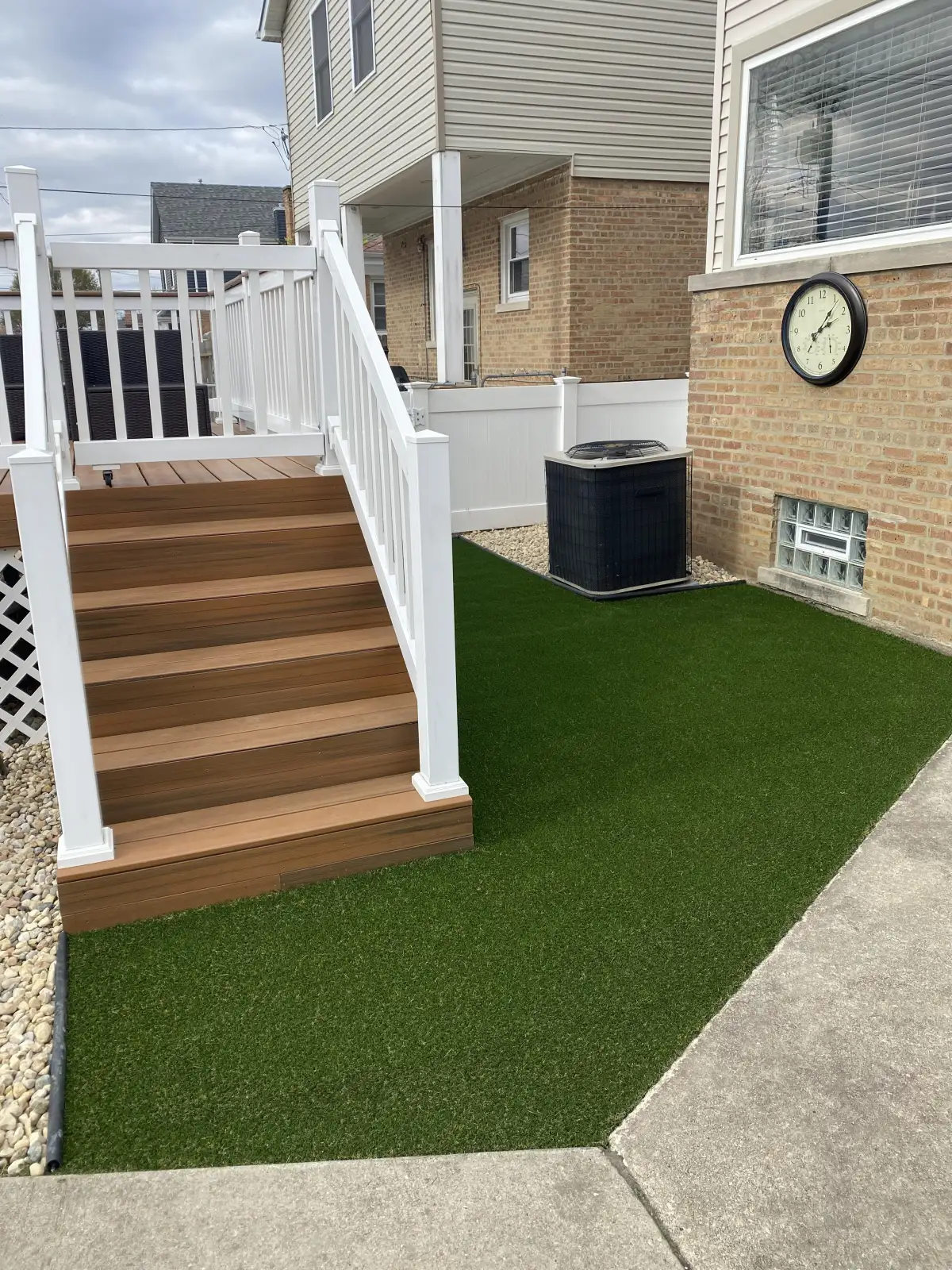
Great Lakes Synthetic Turf uses a Michigan planning range of $13 to $15 per square foot for many professional residential turf installations. That makes square footage useful for early budgeting, but not sufficient for comparing bids. The price has to cover the surface and the work that makes it perform: removal, excavation, drainage, compacted base, secure edges, seams, infill, transitions, and cleanup.
This guide focuses on reading the quote itself. For a broader discussion of project types and long-term ownership, see the Michigan artificial turf cost guide. To understand the actual service, visit artificial grass installation in Michigan.
Fast answer: at $13 to $15 per square foot, 450 square feet calculates to $5,850–$6,750 and 1,000 square feet calculates to $13,000–$15,000. Those are planning examples, not property-specific quotes. Small footprints, poor access, drainage corrections, specialty materials, or detailed edges can move the installed total.
Artificial grass cost examples by square footage
Start with the measured installation area and multiply it by the published planning range. The table shows the arithmetic—not a promise that every yard will price inside it.
| Measured area | At $13 per sq. ft. | At $15 per sq. ft. | What to verify |
|---|---|---|---|
| 450 sq. ft. | $5,850 | $6,750 | Minimum project costs, access, delivery, disposal, curves, and edge length |
| 1,000 sq. ft. | $13,000 | $15,000 | Excavation, drainage, base depth, turf, infill, seams, and transitions |
Installed area and purchased material are not always identical. Roll dimensions, grain direction, curves, obstacles, and seam placement can require cuts and additional material. Ask the estimator to explain how the measured footprint became the quantity in the proposal.
What a complete installed price should account for
A low square-foot number is hard to evaluate until the written scope defines what it buys. Compare these five parts line by line.
1. Removal, excavation, and disposal
The existing lawn, soil, roots, landscape material, or old surface has to be addressed before a stable base can be built. Confirm the excavation assumptions, what will be hauled away, and whether disposal is included. A clear proposal should not leave a homeowner guessing who handles removed material.
2. Grade, drainage, and compacted base
The prepared base carries the surface and gives water a route through the system. Existing low spots, downspouts, compacted subsoil, and hardscape edges may require more than standard preparation. Ask where water will move after it passes through the turf. If the property already holds water, compare the proposal with the site's drainage options instead of assuming artificial grass alone will solve it.
3. Turf and infill selected for the use
A display lawn, play area, dog run, pool border, and putting surface do not have the same performance needs. The quote should name the turf and infill, connect them to the intended use, and explain any alternate. A surface that costs less but does not suit traffic, pets, drainage, or cleaning is not an equal comparison.
4. Edges, seams, cuts, and transitions
Compact yards can have a high ratio of detail work to square footage. Curves, planting beds, pavers, steps, fences, utilities, and narrow strips add cutting and edge work. Confirm how the perimeter will be restrained, where seams are expected, and how the turf will meet patios, walks, and other fixed surfaces.
5. Access, mobilization, and final cleanup
Gate width and the route from the street to the work area affect how equipment, aggregate, rolls, and removed material move through the property. A 450-square-foot enclosed side yard can demand more handling per square foot than a larger open lawn. The scope should identify access assumptions, staging, surface protection, cleanup, and any work the property owner must complete first.
Why smaller projects can cost more per square foot
Some costs occur whether the installation is 450 or 1,000 square feet: bringing equipment and material to the property, preparing a crew, unloading, cutting rolls, setting up compaction equipment, and removing debris. Spreading those costs across a smaller area can raise the unit price.
Shape matters too. A simple rectangle can use material and labor efficiently. A smaller design with several curves, islands, obstacles, or hardscape transitions may require more cuts, more edge restraint, and more offcut material. This is why the best comparison starts with the same measured plan and the same construction scope, not only the lowest advertised rate.
How to compare artificial grass quotes fairly
Place proposals side by side and mark each item as included, excluded, or not specified. If one number is much lower, the gaps usually tell you which follow-up questions to ask.
- Area: measured footprint, material quantity, and allowance for cuts or waste.
- Preparation: removal, excavation, disposal, grading, aggregate type and depth, and compaction.
- Water: drainage route, downspout or low-spot corrections, and responsibility for additional drainage work.
- Finish: named turf, infill, perimeter restraint, seam plan, transitions, grooming, and cleanup.
- Project terms: access assumptions, schedule conditions, homeowner responsibilities, exclusions, and change approval.
- Coverage: separate product and workmanship warranty terms, including who handles each type of concern.
Also separate a material-only price from an installed-system price. A roll of artificial grass is not directly comparable with a professional proposal that includes earthwork, aggregate, drainage planning, edge containment, infill, labor, and disposal. DIY budgeting should include equipment, delivery, compaction, cutting and seaming supplies, surplus material, and a plan for excavated soil—not just the turf roll.
Artificial Grass Installation
Review how lawn use, drainage, base work, edges, seams, and finish details shape the complete system.
Benton Harbor Service Area
See turf, drainage, putting green, and outdoor services available for Benton Harbor properties.
Michigan Turf Cost Guide
Explore the site's broader breakdown of project types, cost drivers, and ownership considerations.
Michigan conditions belong in the estimate
For Michigan properties, the proposal should explain how the base and drainage plan respond to rainfall, snowmelt, and freeze-thaw movement. That does not mean every yard needs the same solution. Existing grade, soil, downspouts, shade, traffic, and nearby hardscape decide what preparation is appropriate.
Great Lakes Synthetic Turf serves Benton Harbor, but a city name is not a substitute for a property review. A quote for a Benton Harbor artificial grass project should respond to the actual water patterns, access, and use of that yard. The same standard applies throughout the company's Michigan coverage.
Get a project-specific artificial grass estimate
Use the guided online estimator to share dimensions, photos, current surface, intended use, pets, wet areas, gates, and nearby hardscape. If you want to call or email first, the Great Lakes Synthetic Turf contact page lists both options.
Frequently Asked Questions
How much does 1,000 square feet of artificial grass cost to install?
Using Great Lakes Synthetic Turf's Michigan planning range of $13 to $15 per square foot, simple arithmetic puts 1,000 square feet at $13,000 to $15,000. The measured installation can fall outside that range because removal, access, drainage, base work, material selection, seams, edges, and transitions affect the final scope.
What is the price to install 450 square feet of artificial turf?
At the same $13 to $15 Michigan planning range, 450 square feet calculates to $5,850 to $6,750. Treat that as a starting point, not a quote. Smaller projects may carry a higher per-square-foot cost when mobilization, equipment, delivery, disposal, or difficult access is spread across less area.
How much does it cost for someone to lay artificial grass?
Professional installation pricing should account for more than laying the surface. A complete proposal may include removal and disposal, excavation, grade and drainage work, aggregate base and compaction, perimeter restraint, turf and infill, seams, transitions, final grooming, and cleanup. Compare those inclusions before comparing totals.
Why can two artificial grass quotes for the same size yard be different?
The proposals may assume different excavation, base depth, drainage corrections, disposal, access, turf, infill, edge restraint, seam layout, transitions, or cleanup. Ask each installer to define quantities, materials, inclusions, exclusions, and how changes are approved.
How much does a retailer charge to install artificial grass?
Retail installation prices vary by market, site conditions, product, and the contractor completing the work, so a current project-specific proposal is more useful than a general retailer figure. Compare the retailer's written scope with local installer proposals line by line, especially preparation, drainage, edges, seams, disposal, and warranty responsibility.