
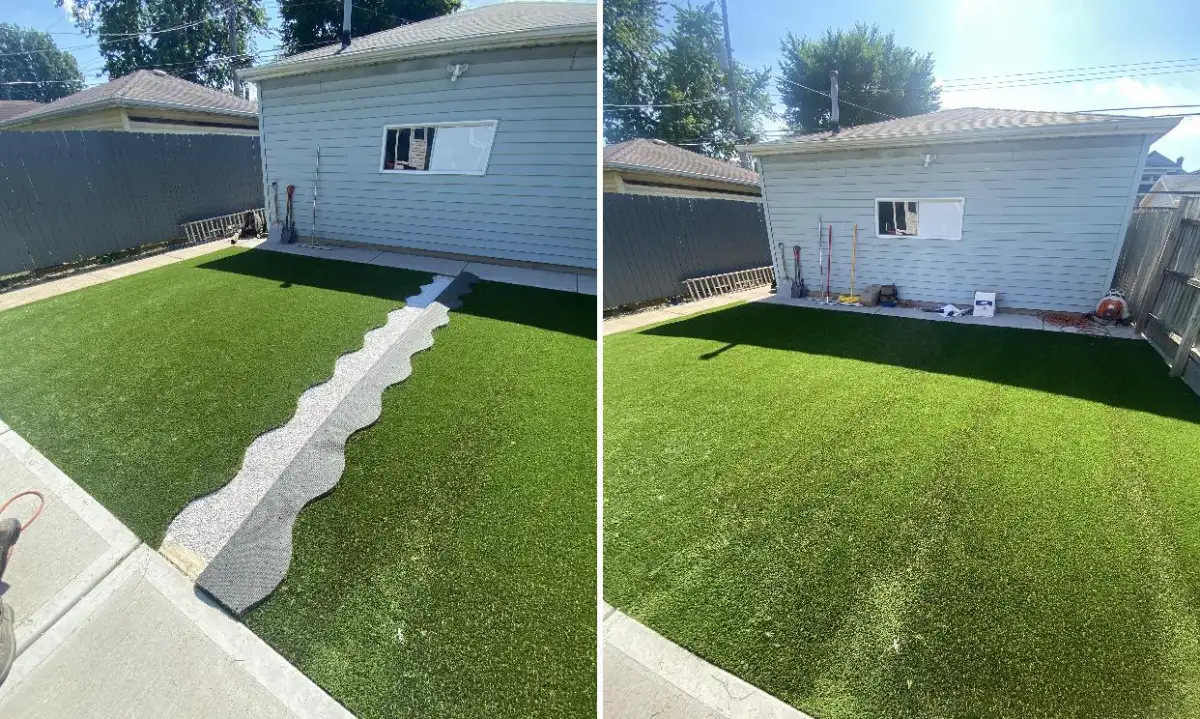
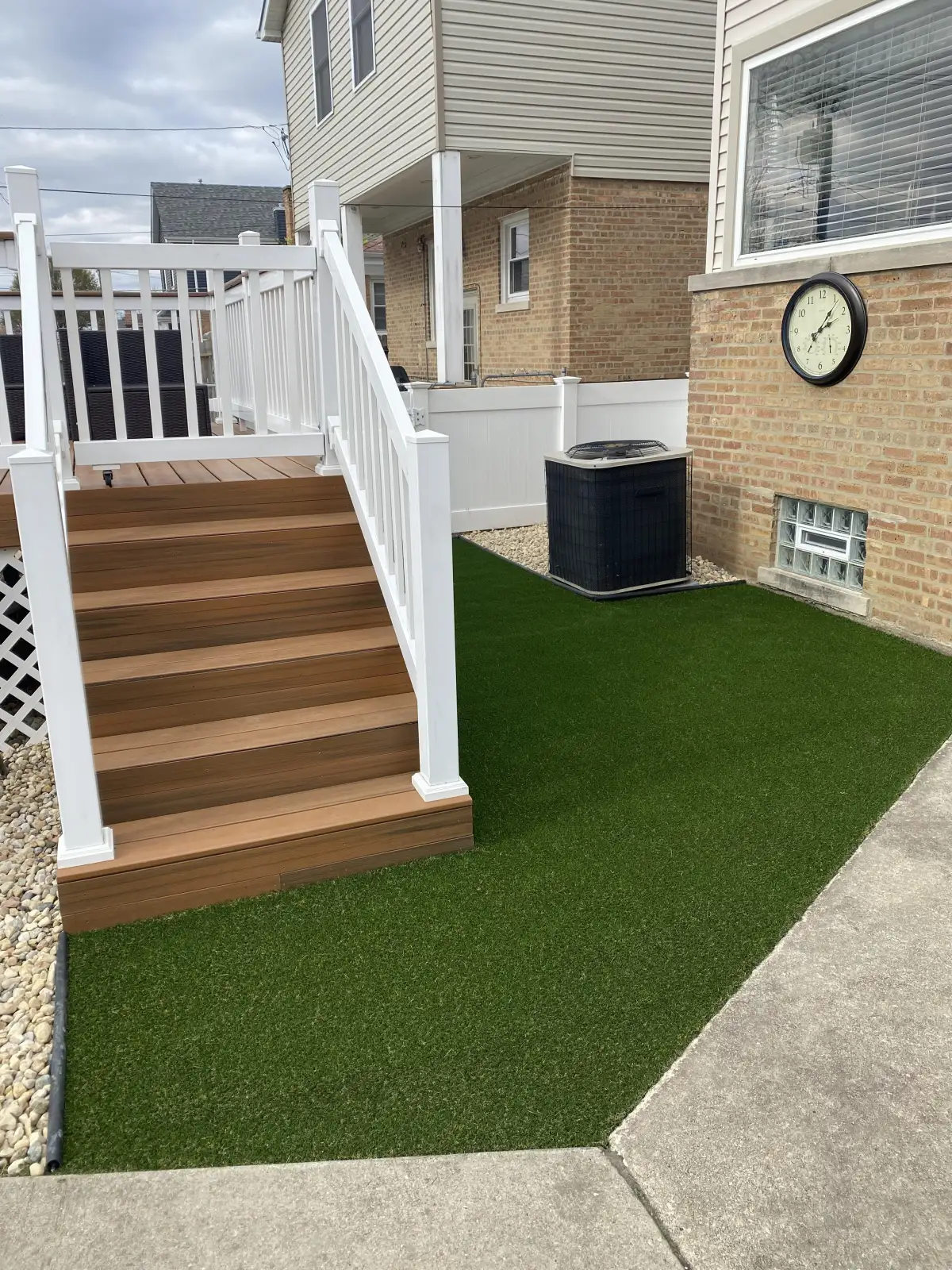
Artificial turf installation in Michigan typically costs between $13 and $15 per square foot, with most residential projects totaling $6,500 to $22,000. The final price depends on your project size, the turf product you choose, how much base preparation your site needs, and whether drainage work is required.
This guide breaks down exactly where your money goes, what factors push costs higher or lower, and how to compare quotes from different installers so you make a confident decision.
Cost Breakdown: Where Your Money Goes
Every artificial turf installation has three main cost components. Understanding each one helps you evaluate quotes and spot where corners might be cut.
Materials: $4 to $5 Per Square Foot
The turf product itself makes up roughly a third of your total cost. Residential-grade turf with a natural look and soft feel typically runs $4 to $5 per square foot. Premium products with enhanced UV stabilization, heat-reducing technology, or specialty fibers for putting greens can reach $6 or more per square foot.
American-made turf products cost more than imports, but they come with superior UV stabilization, consistent pile height, and materials that have been tested to meet ASTM safety standards. Cheap imported turf may look similar in the showroom, but it fades faster, mats down sooner, and often lacks the durability ratings needed for Michigan's climate.
Labor: $5 to $6 Per Square Foot
Labor costs cover site excavation, grading, base compaction, turf cutting and seaming, edge installation, infill application, and final grooming. A qualified crew will spend one to three days on a typical residential project depending on the size and complexity.
The experience of the installation crew directly affects how long your turf will last. Proper seaming technique, correct nail spacing, and precise grading are skills that take years to develop. A lower labor quote may mean less experienced installers, which often leads to visible seams, wrinkles, or drainage problems within the first year.
Base Preparation: $4 to $5 Per Square Foot
This is the component most commonly skipped or minimized by budget installers, and it is the most important part of the entire project. Proper base preparation includes excavating 3 to 4 inches of existing soil, laying geotextile weed barrier, adding compacted drainage stone (typically Class II road base or decomposed granite), and building a framed edge system to hold everything in place.
In Michigan, the drainage stone base is not optional. Without it, water pools under the turf during spring snowmelt and fall rains, creating a breeding ground for mold. In winter, that trapped water freezes and causes frost heave that buckles the turf surface. A proper drainage stone base prevents all of these problems.
Factors That Affect Your Total Cost
Project Size
Larger projects have a lower cost per square foot because the fixed costs of mobilization, equipment rental, and site access get spread across more area. A 500-square-foot project might average $15 per square foot, while a 2,000-square-foot project might come in at $13 per square foot.
Turf Grade and Product Selection
Standard residential turf with a 1.5-inch pile height is the most affordable option. Taller, denser products that mimic specific grass varieties cost more. Putting green turf requires specialty nylon fiber and precision manufacturing, putting it at the top of the price range. Pet-specific turf with antimicrobial infill and enhanced drainage falls in the mid-range.
Existing Site Conditions
A flat, well-drained yard with easy access is the simplest installation. Slopes require additional grading and potentially retaining structures. Rocky soil means harder excavation. Sites with poor drainage may need French drains or additional stone base depth. Clay-heavy Michigan soils -- common in the Grand Rapids, Lansing, and Detroit areas -- often require more extensive base preparation than sandy soils found along the lakeshore.
Drainage Requirements
Every installation needs a drainage plan, but the scope varies. A yard that already drains well may need only the standard stone base layer. A low-lying area or one next to a downspout might require catch basins, French drains, or a thicker stone base to manage water volume.
Access and Logistics
If materials need to be carried through a narrow side yard instead of delivered directly to the backyard, labor costs increase. Second-story or rooftop installations require specialized equipment. Projects more than 150 miles from our White Cloud headquarters may include a travel fee, which we always disclose upfront.
Cost by Project Type
| Project Type | Typical Size | Cost Per Sq Ft | Total Range |
|---|---|---|---|
| Residential Front/Back Lawn | 800 - 2,500 sq ft | $13 - $15 | $10,400 - $37,500 |
| Pet Area / Dog Run | 200 - 800 sq ft | $13 - $15 | $2,600 - $12,000 |
| Backyard Putting Green | 300 - 1,000 sq ft | $25 - $30 | $7,500 - $30,000 |
| Commercial / Sports Area | 2,000 - 10,000+ sq ft | $11 - $14 | $22,000 - $140,000+ |
| Small Side Yard / Patio Area | 100 - 400 sq ft | $14 - $16 | $1,400 - $6,400 |
Note: Putting greens cost more per square foot because the turf product is a premium nylon fiber, the base must be graded to precise tolerances for accurate ball roll, and the installation requires more skilled labor to shape contours and transition zones.
Hidden Costs to Watch For
When comparing quotes, make sure each estimate includes the same scope. Here are costs that are sometimes left out of low-ball quotes:
- Excavation and soil removal -- Some quotes assume you will handle removing the excavated soil yourself. Make sure haul-off is included.
- Edge containment -- Proper framed edges with solid perimeter boards cost more than plastic landscape edging, but they last significantly longer and prevent the turf from shifting.
- Infill material -- Silica sand, crumb rubber, or specialty antimicrobial infill is applied after installation. Some quotes exclude infill, which is a required component.
- Drainage improvements -- If your site has drainage issues, the cost of French drains or additional stone base should be in the quote, not discovered as an add-on mid-project.
- Weed barrier -- Commercial-grade geotextile fabric should be laid before the stone base. Skipping it saves a few cents per square foot but creates weed problems within two years.
Long-Term Savings: The 10-Year View
Artificial turf has a higher upfront cost than laying natural sod, but the ongoing savings are substantial. Here is what a typical Michigan homeowner spends annually maintaining 1,000 square feet of natural grass versus the same area in artificial turf:
| Annual Expense | Natural Grass | Artificial Turf |
|---|---|---|
| Mowing (weekly, Apr-Oct) | $800 - $1,200 | $0 |
| Watering | $200 - $400 | $0 |
| Fertilizer and Weed Control | $150 - $300 | $0 |
| Overseeding / Patching | $100 - $200 | $0 |
| Equipment / Fuel | $100 - $200 | $0 |
| Occasional Brushing / Rinse | $0 | $25 - $50 |
| Annual Total | $1,350 - $2,300 | $25 - $50 |
Over 10 years, that natural grass costs $13,500 to $23,000 in maintenance alone -- on top of the original sod cost. A $10,000 artificial turf installation pays for itself within 5 to 7 years through eliminated maintenance costs, and then saves you $1,300 to $2,250 every year after that. The turf itself lasts 15 to 20 years with proper installation and minimal care.
There is also the time factor. Mowing, edging, fertilizing, and watering a lawn takes 40 to 60 hours per year in Michigan. That is time you get back permanently with artificial turf.
Getting an Accurate Estimate
The only way to get an accurate price for your project is to have an installer visit your property. Every site is different -- soil type, grade, drainage patterns, and access all affect the final number. Be skeptical of any company that quotes a price over the phone without seeing the site.
When comparing quotes, ask these questions:
- What type of base material is included, and how deep is the base layer?
- What edge containment system do you use?
- Where is the turf manufactured, and what is the warranty?
- Is excavation and soil haul-off included?
- What infill material is used, and how much?
- Who will be on site -- employees or subcontractors?
At Great Lakes Synthetic Turf, every project starts with a free on-site estimate where we assess your specific conditions and walk you through the full scope of work. We use a proper drainage stone base, framed edge system, and American-made turf on every installation -- and we include all of those components in our quotes with no hidden fees.
Regional Cost Variations Across Michigan
Artificial turf installation costs are not uniform across the state. Several regional factors influence your final price depending on where you live in Michigan.
Detroit metro and Southeast Michigan. The most competitive market for turf installers, which tends to keep pricing moderate despite higher general labor costs. Access to materials is easy through multiple distributors, and the flat terrain common in Wayne, Oakland, and Macomb counties means fewer grading challenges. However, the heavy clay soil throughout the metro area almost always requires additional base preparation to manage drainage. Expect your project to fall in the mid-range of $13 to $15 per square foot for residential installations.
Grand Rapids and West Michigan. Moderate pricing with excellent access to materials. West Michigan's mixed soil conditions -- sandy near the lakeshore, clay inland -- mean base preparation costs vary significantly from property to property. A home in Norton Shores may need less drainage stone than one in Byron Center. Lake-effect snow zones also benefit from heavier base installations that handle the larger snowmelt volumes typical of properties within 30 miles of Lake Michigan.
Traverse City and Northern Michigan. Projects in Northern Michigan typically cost 5 to 10 percent more than the state average due to material delivery distances and the shorter installation season. The rocky, sandy soils common in the northern Lower Peninsula are actually easier to excavate than southern clay, which partially offsets the travel premium. Properties along Grand Traverse Bay, Torch Lake, and the Leelanau Peninsula are popular locations for putting greens and luxury turf installations.
Rural and Upper Peninsula locations. Remote properties more than 150 miles from our White Cloud headquarters may include a mobilization fee that covers crew travel, equipment transport, and lodging for multi-day projects. We always disclose this cost upfront during the estimate process. The trade-off is that rural properties tend to have more space, better natural drainage, and fewer access constraints, which can reduce other installation costs.
Financing Your Artificial Turf Project
The upfront cost of artificial turf is the primary barrier for most homeowners considering the switch from natural grass. Several options can spread that cost over time without delaying your project.
Home improvement loans through your bank or credit union offer fixed rates and predictable monthly payments, typically over 3 to 7 years. Home equity lines of credit provide flexible borrowing against your property value, often at lower interest rates than unsecured loans. Some Michigan homeowners use personal savings for smaller projects like pet turf areas or putting greens under 500 square feet, then finance larger lawn replacement projects separately.
When evaluating financing, factor in the $1,300 to $2,250 annual savings from eliminated lawn maintenance. A $13,000 turf installation financed at 7 percent over 5 years costs roughly $257 per month -- while your eliminated lawn care expenses save $110 to $190 per month. The net out-of-pocket difference is far smaller than the installation price suggests, and after the loan is paid off, the savings continue for another 10 to 15 years of the turf's lifespan.
Ready for Your Free Estimate?
Get a detailed, transparent quote for your artificial turf installation in Michigan. We serve the entire state from our White Cloud headquarters and build every project to last.