
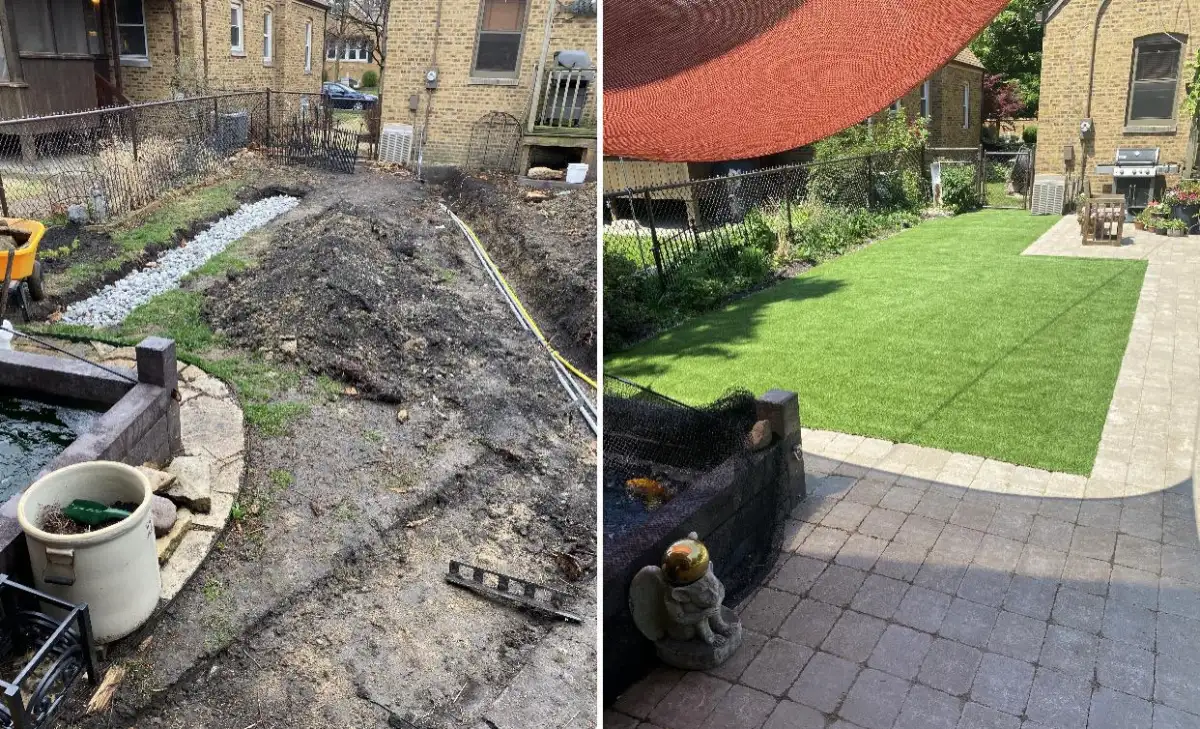
Before booking artificial turf installation in Benton Harbor, ask for an explanation of the whole system—not just a turf sample and a square-foot price. The intended use, water movement, excavation, prepared base, edge details, access, and long-term care all influence whether the finished surface works for the property.
This checklist is grounded in the questions homeowners are currently asking about installation cost, maintenance, permits, and common artificial-grass problems. For service details, visit the artificial turf installation page and the Benton Harbor service area page.
Start with the property: note where water stands after rain, nearby downspouts, trees and roots, irrigation, steps, gates, utility equipment, adjoining pavers or concrete, pets, and the way people will use the area.
1. What job does the turf need to do?
A lawn used mainly for appearance calls for different decisions than a dog run, play area, pool surround, or practice green. Explain whether the priority is avoiding mud, reducing mowing, creating a washable pet area, or making a small yard more usable. That answer should guide the turf, backing, infill, seam layout, edge treatment, and cleaning plan.
If dogs are a primary concern, compare the proposal with the details on pet turf installation. If practice performance matters, review putting green installation rather than treating every synthetic surface as interchangeable.
2. Where will rain and snowmelt go?
A permeable turf backing is only the beginning of the drainage path. Water still has to move through the prepared base and away from the area without being trapped by a low grade, dense soil, edging, or surrounding hardscape. Ask the installer to point out where water enters the project area, how the finished elevations will move it, and where it can discharge.
Stormwater management is a documented local concern: the EPA has described green-infrastructure investment in Benton Harbor’s Ox Creek watershed. That public work does not diagnose a private yard, but it reinforces why a Benton Harbor proposal should address existing water behavior. A wet low spot may require grading or a separate drainage solution; turf alone does not fix the source of standing water.
3. What will be removed and rebuilt below the turf?
Ask the installer to describe the installation from the ground up. A useful scope identifies removal and disposal, excavation, grade correction, aggregate base, compaction, perimeter restraint, turf layout, seams, infill, transitions, and cleanup. “Standard preparation” is not specific enough unless the proposal defines what that means for the property.
Great Lakes Synthetic Turf describes its installation approach as using drainage stone base preparation and framed edge containment. The property plan should still show how those elements meet existing walks, patios, planting beds, fences, drains, steps, and other fixed edges.
4. Which turf, infill, seams, and edges fit the use?
Ask why the recommended turf and infill suit the planned traffic, pets, appearance, drainage, surface feel, and cleaning routine. View samples outdoors and from the direction the lawn will usually be seen. Then ask where seams will fall, which way the turf grain will face, and how the perimeter will be secured.
These construction details help prevent familiar complaints such as lifted edges, visible joins, shifting surfaces, uneven areas, or a system that is hard to clean. The best-looking sample is not automatically the best complete installation.
Artificial Turf Installation
See how site evaluation, base preparation, drainage, edge containment, turf, and infill work together.
Benton Harbor Service Area
Review the turf, drainage, putting green, and outdoor services available for area properties.
Michigan Turf Cost Guide
Learn which property, access, material, and construction variables shape an installed estimate.
5. What changes the installed price?
Homeowners often ask what 1,000 square feet of artificial turf should cost. Square footage is important, but it cannot account for what is already on the site. Removal, excavation, grade, drainage, base depth, gate access, hauling distance, material selection, curves, seams, edging, and transitions can make two equal-size projects very different.
Compare measured written scopes instead of headline totals. Confirm what the price includes, what is excluded, who handles disposal and cleanup, and how an unexpected site condition or requested change will be approved. The Michigan artificial turf cost guide explains those variables in more detail.
6. What has to happen before installation day?
Ask about utility marking, irrigation, gates, material staging, equipment access, household preparation, and protection for nearby surfaces. Also confirm who is responsible for checking current city requirements, easements, drainage rules, and any neighborhood or association approval that applies to the actual scope.
Timing should be property-specific as well. Footprint, excavation, access, weather, drainage work, curves, hardscape transitions, and specialty features all affect the schedule. Ask for the anticipated sequence and the conditions that could move the dates before relying on a broad “typical” timeline.
7. What maintenance and tradeoffs should I expect?
Artificial turf removes mowing from the routine, but it is not maintenance-free. Normal care can include clearing leaves and debris, rinsing as needed, brushing high-traffic fibers, cleaning pet areas, and checking infill, seams, edges, and drainage. The right frequency depends on shade, trees, pets, and traffic; the Michigan turf maintenance guide adds seasonal detail.
Ask about tradeoffs, too. Turf can warm in direct sun, has an upfront installation cost, and will eventually age. Some homeowners remove artificial grass because their landscape use changes; others respond to problems caused by weak base work, drainage, seams, or edges. A candid discussion now is more useful than discovering a mismatch later.
8. What belongs in the written proposal?
- The measured footprint and intended use of each area.
- Removal, excavation, grade, base, compaction, edges, seams, infill, transitions, and cleanup.
- The route water will take through and away from the installation.
- Named turf and infill selections, plus any approved alternates.
- Access assumptions, homeowner responsibilities, schedule conditions, and exclusions.
- Separate product and workmanship warranty terms, including coverage, exclusions, and how to report a concern.
- Responsibility for permits, utility marking, easement checks, and other required approvals.
When each answer is tied to the actual property, it becomes easier to compare installation plans on substance instead of choosing by sample color or bottom-line price alone.
Talk through your Benton Harbor property
Visit the Great Lakes Synthetic Turf contact page for phone and email options, or use the online estimator to share the approximate dimensions, photos, intended use, pets, wet areas, and access details.
Frequently Asked Questions
How much does it cost to install 1,000 square feet of artificial turf?
A reliable total cannot be calculated from square footage alone. Existing surface removal, excavation, grade, drainage, base depth, access, turf and infill selection, curves, seams, edging, and transitions all affect an installed estimate. Ask for a measured, itemized scope for the property.
Does artificial turf fix a wet or muddy Benton Harbor yard?
Artificial turf can be part of a free-draining surface, but it does not by itself correct a low grade, downspout discharge, compacted subsoil, or a missing outlet. The installation plan should explain how water travels through the turf and prepared base and where it goes from there.
What maintenance does artificial turf require in Michigan?
Typical care includes removing leaves and debris, rinsing as needed, brushing high-traffic fibers, cleaning pet areas, and periodically checking infill, seams, edges, and drainage. Snow should be removed only when access is necessary, using tools and methods recommended for the selected turf.
Why do some homeowners remove artificial grass?
Reasons can include a change in how the yard is used, an aging surface, heat in unshaded areas, or installation problems such as poor drainage, movement at edges, visible seams, and uneven base work. Discussing those tradeoffs before booking helps match the system to the property.
Do I need a permit for artificial turf installation in Benton Harbor?
Requirements depend on the property and full scope. Before work begins, confirm current city rules, utility marking, easements, drainage requirements, and any association approval that applies. The written proposal should identify who is responsible for each approval.